Premium surface story
Carbon-positioned builds give buyers a clearer performance message for control, spin, feel, and premium retail placement.
Performance Paddles
Premium SiC matrix performance paddle — durable spin, MPP core, private label ready for Performance paddle brands and distributors. This platform can be positioned around control, power, sweet-spot stability, and premium private label presentation.

Product Positioning
Translate the specification into a retail, club, ecommerce, or private label selling story before sample development.
Carbon-positioned builds give buyers a clearer performance message for control, spin, feel, and premium retail placement.
Use material, thickness, shape, finish, and packaging levels to create good-better-best private label paddle tiers.
Material, core, thickness, shape, weight target, grip, edge guard, artwork, packaging, and carton marks can be confirmed before samples.
ACE can prepare samples, packaging direction, product references, and repeatable bulk production details for the buyer's channel.
Product Details
Use this product as a standard sourcing reference, private label starting point, or OEM/ODM development base.
| Product ID | ACE-055 |
|---|---|
| Category | Performance Paddles |
| Product Type | Pickleball Paddle |
| Material | Silicon carbide (SiC) matrix face |
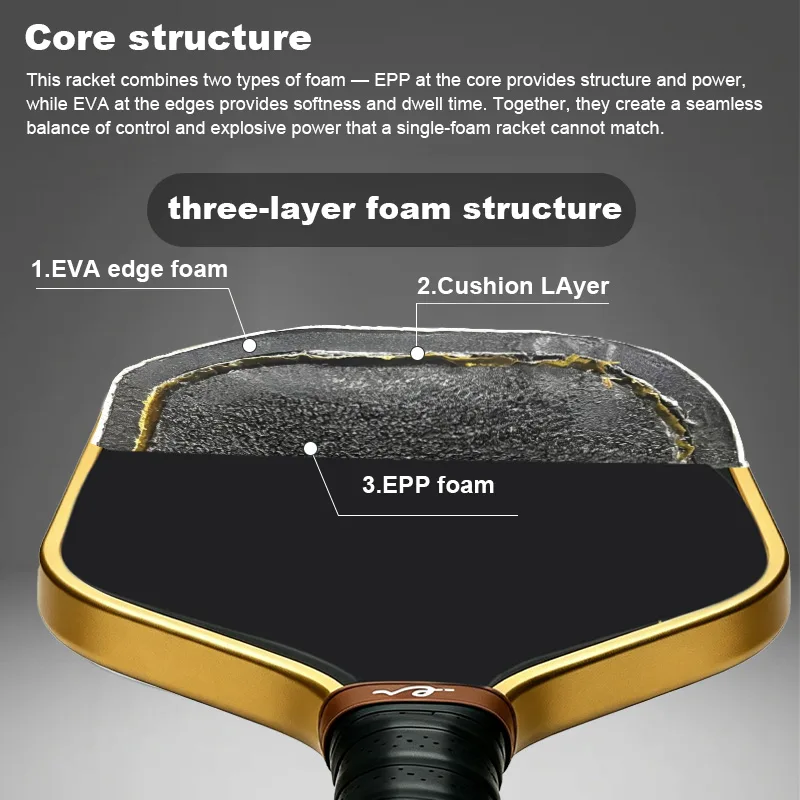
| Core | MPP microcellular foam core with TPEE dynamic return ring |
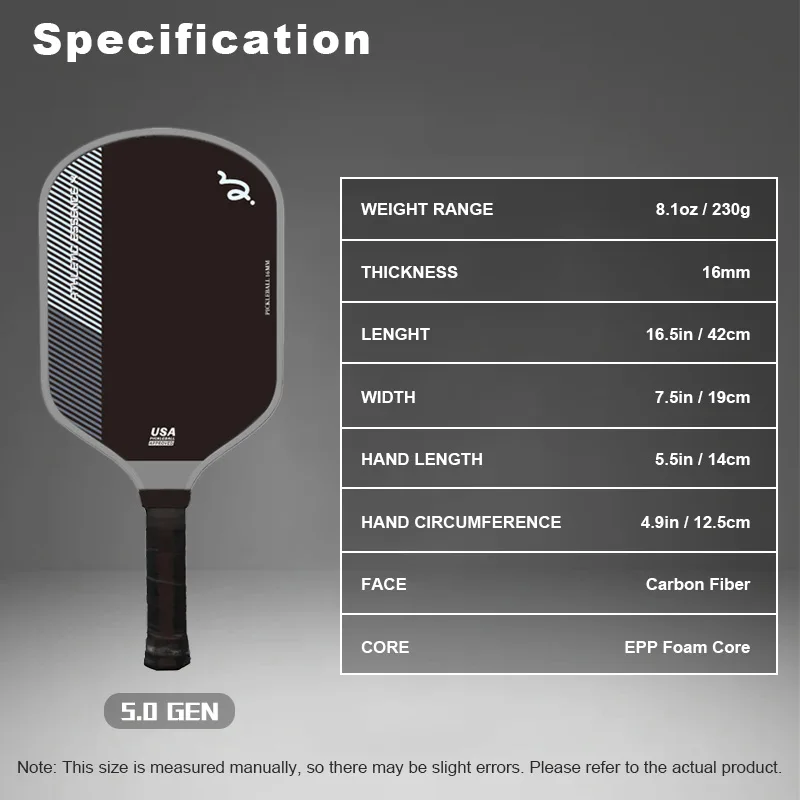
| Thickness | 16mm |
| Buyer Fit | Performance paddle brands, distributors, premium retailers, club pro shops, and private label programs |
| Images | 6 product images |
| Customization | Logo, full-face graphics, grip, edge guard, packaging, carton label, and sample approval |


Technology Deep Dive
Most paddles are described by one headline material. The Breaking Dawn is built from three structures that each solve a different problem: a silicon carbide matrix face for spin that survives contact, an MPP microcellular foam core for power that stays predictable, and a TPEE dynamic return ring that keeps the sweet spot honest on off-center hits. The sections below explain what each layer does and what a buyer should verify before committing to a private label program.
Spin comes from friction between the ball and the face, and friction is a wear surface. A face that relies on a sprayed coating or a peel-ply layer starts strong and then loses grip as the structure generating the spin is abraded. Brands feel this as a strong first month followed by dead-face complaints that they, not the factory, end up owning.
The Breaking Dawn uses a silicon carbide matrix surface. Silicon carbide is an extremely hard abrasive — the same family used for grinding media precisely because it resists being worn down. The grit is bonded into the face rather than resting on top of it, so the texture is distributed through the surface instead of sitting on a coating that can flatten or flake.
For a private label program this removes the most common cause of a second-year reputation problem: you are not promising that a coating survives a season, you are specifying a face whose grip is a property of the material.
Below the face sits an MPP microcellular foam core. The distinction that matters is between a core that produces a high number once and a core that produces the same number every time. Honeycomb and lower-density foam cores can deliver strong peak power, but the response shifts with how squarely the ball is struck and how much the core has been compressed.
Microcellular foam is engineered for a more uniform compression response, so energy return does not depend on hitting one specific region of the face. That is the difference between marketing a peak-power figure and marketing predictability — and predictability is the harder claim to make and the easier one to defend with a customer.
The most common complaint about performance paddles is not power and it is not spin. It is off-center contact. A paddle can feel excellent in a warm-up rally and then produce a weak, twisting response the moment a ball catches the edge of the face — which, in real match play, is most of the time.
The Breaking Dawn addresses this with a TPEE dynamic return ring. TPEE is a thermoplastic elastomer: it deforms under load and returns to shape, a combination of flexibility and recovery that rigid perimeter materials do not have. Positioned around the perimeter, the ring absorbs the energy of an off-center strike and returns it while limiting how sharply the face twists.
The intent is a sweet spot that behaves more consistently across the face, narrowing the gap between a centre hit and a slight mis-hit. For coaches and club buyers that is often what separates a paddle suited to developing players from one that only suits players whose contact point is already under control.

Grip is the least glamorous component and one of the most common sources of returned product. A grip that becomes slick under load costs the player confidence on powerful swings, and in humid conditions or long tournament days it is the first part of the paddle to fail expectations.
The Breaking Dawn uses a breathable, slip-resistant grip: breathability manages moisture across a long session, while slip resistance keeps a powerful swing connected to the hand. The handle is also specified with two-handed backhands in mind, which changes how the paddle balances and how much handle length is actually in use — a specification worth confirming at sample stage rather than assuming it carries over from another platform.

This is a paddle for competitive players who need their equipment to hold its character over time. It is not aimed at the entry-level buyer choosing on price, and not at the collector segment buying on graphics. It is aimed at the player who has already developed a game and has been disappointed by a paddle that changed behaviour after a few months.
That shapes how a brand should sell it. The strongest arguments are durability of spin, consistency of power, and stability on off-center contact. The weakest are the ones any paddle can claim — light feel, comfortable grip, attractive design. A listing built around the first three converts differently from one built around the last three, even though both describe the same physical product.
ACE builds several performance directions, and they solve different commercial problems. A fiberglass face suits colourful entry and mid-market programs where artwork variety and accessible pricing drive the decision. A PP honeycomb build suits buyers who want a familiar specification that is easy to explain. A T700 carbon or titanium-wire direction suits programs selling a premium material story to buyers who already know the vocabulary.
The Breaking Dawn sits above those on the durability of its spin story. Where a basic composite face is expected to be replaced as the player improves, this platform is designed to be the paddle the player keeps — which makes it a fit for a flagship SKU, a club house-brand paddle, or a distributor who wants one strong performance reference rather than a deep ladder of similar options.
The platform accepts private label treatment. Face graphics, logo placement, grip colour, edge guard, butt cap, and packaging can all be specified before production, so one production direction can support several SKUs across different channels without duplicating tooling.
A workable program starts with artwork and specification rather than price: approve the artwork, confirm the handle and grip specification, decide the retail presentation, then sample. Building it in that order avoids the common failure where a brand commits to a packaging format before the paddle specification settles. For a first paddle line, start with one SKU and prove the positioning before expanding.
Confirm the actual face texture and how it is produced, not just that the product is described as textured. Confirm the core density and the finished thickness. Confirm the weight of the sample piece rather than the nominal figure, and confirm the tolerance the factory will hold in production.
The Breaking Dawn is specified at 16 mm thickness with a nominal weight of 230 g ± 10 g, and the dimension drawing shows a width of 18.5 cm. A tolerance of plus or minus ten grams is wide enough for a sensitive player to feel, so buyers shipping to a discerning market should discuss whether a tighter band is achievable rather than assuming the nominal figure is what will arrive.
Manufacturing Specs
These specifications are used as manufacturing references for quoting, sample development, and private label planning.
T700 carbon fiber builds support premium performance positioning, including 14 mm and 16 mm OEM/ODM programs.
| Common sizes | Around 41-42 x 18.7-20.2 cm depending on mold and build |
|---|---|
| Thickness options | 10.5 mm, 14 mm, and 16 mm custom discussions; 16 mm listed examples available |
| Common weight | About 230 g in listed examples |
| Handle range | Around 13.3-14.5 cm handle length, 12.5-13.0 cm grip circumference |
| Surface options | Carbon fiber cloth texture, frosted finish, thermoformed generation options, or custom finish by sample |
ACE can discuss 14 mm and 16 mm paddle programs using T300, T700, fiberglass, and other buyer-approved structures.
| 14 mm direction | Responsive feel, suitable for mid-market and performance private label lines |
|---|---|
| 16 mm direction | Thicker control-oriented platform, suitable for premium private label positioning |
| T300 options | T300 14 mm and T300 16 mm custom builds can be discussed |
| T700 options | T700 14 mm and T700 16 mm custom builds can be discussed |
| Sample rule | Final thickness, core, weight, handle, surface, and packaging should be confirmed by sample |
Build Options
Use these options to define a clearer product line instead of treating every paddle as interchangeable.
Reach and drive-focused shape for buyers positioning a power or advanced performance model.
Larger face and forgiveness story for control-focused, club, retail, and beginner-to-intermediate lines.
Balanced option when one SKU needs to serve broad retail and private label demand.
Shape, handle length, grip circumference, edge guard, and weight target can be reviewed by sample.
B2B Proof
For a factory site, proof should come from process clarity, sample control, and channel-ready presentation rather than unsupported retail review claims.
Image Plan
A stronger product page should show the build, use case, and sales package, not only a single catalog image.
Bundle Paths
Bundle planning helps buyers build an actual retail SKU, club pack, or private label launch kit.
A clean private label set for retail display, ecommerce shipping, and club pro-shop presentation.
Starter bundle for clubs, schools, Amazon sellers, and gift-oriented channels.
Retail box, insert, barcode label, carton mark, and sample approval for brand launches.
FAQ
Use these answers to prepare product requirements before contacting ACE.
Yes. ACE can support logo printing, artwork, grip details, packaging, and carton labels depending on the confirmed product structure.
Yes. Sample approval is recommended before bulk production so you can confirm feel, print, finish, packaging, and specification details.
Yes. Material, core, thickness, shape, weight target, and surface finish can be discussed during OEM/ODM product development.
Related Products
Compare similar product directions before requesting a quote.
 1 images
 1 images
 1 images
ACE-004
Latest-generation performance paddle platform
View details 1 images
ACE-005
Premium private label performance paddle
View details